This is Part 3 of the "Business of One" series. Catch up on Part 1 and Part 2 before diving in.
Imagine you are the CEO of a tech startup. You have a product you believe in. Do you spend six months locked in a room perfecting every feature before anyone sees it?
No. You launch a Minimum Viable Product — the most functional version of your product you can put into the real world right now — and you let the market give you feedback.
As the CEO of your "Business of One," your career works exactly the same way.
The problem is that most job seekers have no idea what their career MVP actually is.
The Hard Truth: Your Resume Is NOT Your MVP
A resume is a static, dead piece of paper designed to be read by a robot — the Applicant Tracking System — and is usually rejected before human eyes ever see it. You cannot build a brand on a piece of paper.
Your true MVP is your LinkedIn profile.
It is a live, searchable, 24/7 landing page for your business. While you sleep, recruiters can find you. While you're in an interview, hiring managers are cross-referencing your story. Your LinkedIn profile works for you around the clock in a way your resume never will.
Your Career MVP in 5 Steps
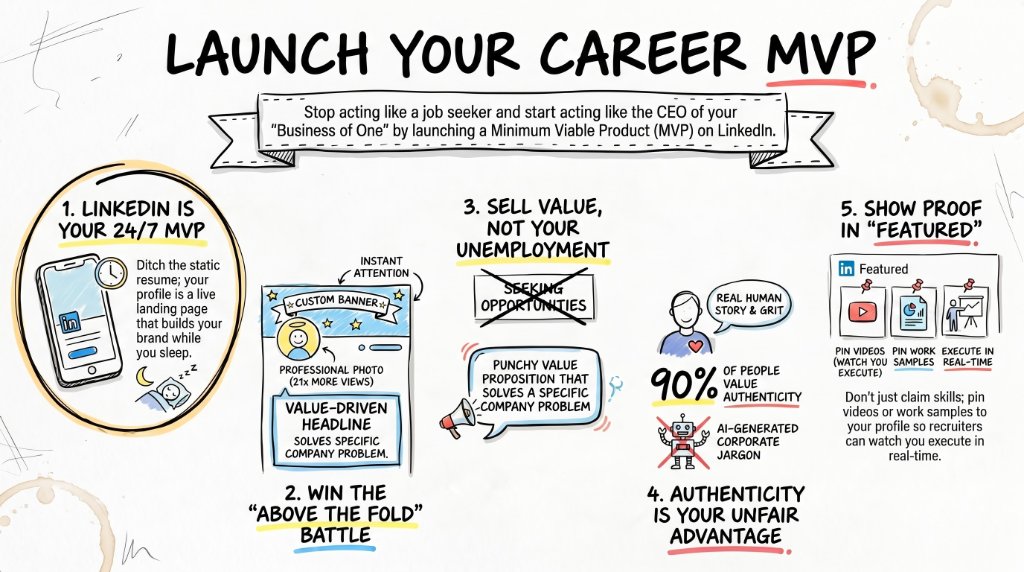
Step 1: Escape the "Professionalism" Trap
This is where the vast majority of people make their biggest mistake. They try to make their LinkedIn profile look incredibly "professional." They stuff it with corporate jargon, list out their degrees, and post pictures of certifications.
Here is the hard truth: in the modern market, nobody cares about your degree, and nobody is moved by your certifications.
We live in an era where AI can write a perfectly formatted, grammatically flawless, highly "professional" resume or cover letter in three seconds. Perfection is now a commodity. If your LinkedIn brand sounds like a sterile corporate robot, you will blend in with the infinite noise of AI-generated content.
To stand out, your brand must do the exact opposite.
It must tell the story of being human.
Showcase your grit. Your unconventional background. Your failures and your pivots. Your authentic voice. You are not selling a list of skills — you are selling the human being who wields them.
Why Authenticity Is Your Unfair Advantage
Think about how humans actually make buying decisions. If you are going to purchase a $1,000 product online, do you just read the manufacturer's feature list? No. You scroll straight to the reviews written by actual people.
Hiring managers are buyers. Offering you an $80,000+ salary is a massive financial commitment. Your resume is just the manufacturer's feature list. But your authentic LinkedIn brand — how you write, how you engage, and how you tell your story — acts as the ultimate 5-star review. It proves to the hiring manager that you are a real, dynamic person they actually want to work alongside every single day.
📊 The data backs this up: A Stackla report found that 90% of consumers say authenticity is important when deciding which brands they support. Hiring managers are no different — they are buying a human being, not a credential list.
Step 2: Win the "Above the Fold" Battle
In software sales, "Above the Fold" refers to everything a buyer sees before they have to scroll down. If that top section doesn't grab their attention immediately, they bounce.
On your LinkedIn MVP, your "Above the Fold" real estate consists of three things:
- Your Banner — Your company's billboard. Not the grey default box. A visual that represents your industry or personal brand.
- Your Headshot — A professional photo. LinkedIn's own data shows profiles with a photo get up to 21x more views.
- Your Headline — Not your job title. A hook.
Treat this section like prime advertising space, because that is exactly what it is.
Step 3: Kill the "Seeking Opportunities" Headline
This is the single biggest mistake job seekers make. They use their headline to broadcast:
"Actively Seeking SDR Opportunities."
If you were evaluating a software company and their homepage said "Please buy our software, we really need the money," you would run. It signals desperation, not value.
Your headline is your value proposition. It should tell the market exactly who you are and what problem you solve.
| ❌ Weak (Desperate) | ✅ Strong (Value-Driven) |
|---|---|
| Recent Graduate | Looking for Tech Sales Roles | B2B Sales Professional | Helping Enterprise Tech Teams Generate Pipeline and Scale Revenue |
Sell your value. Do not advertise your unemployment.
Step 4: Turn Authenticity Into Your Unfair Advantage
The candidates who are beating the system right now are not the ones with the most polished profiles — they are the ones with the most human ones.
Share your journey. Post about a cold call that went sideways and what you learned. Write about why you are making a career pivot. Let people see the real process.
According to SHRM, 92% of recruiters use social media in their hiring process, and 87% use LinkedIn specifically. They are not just looking at your credentials — they are evaluating whether they want to work with you as a human being.
Step 5: The "Featured" Section — Where Performance Currency Lives
In Part 2, we talked about building Performance Currency — hard, undeniable proof that you can actually do the job.
Your LinkedIn "Featured" section is where that currency gets displayed.
Your resume is a list of claims. Your Featured section is your portfolio of proof.
When you execute live B2B sales tasks — recording a 60-second Loom video of a mock cold call, or pinning a screenshot of a perfectly organized CRM pipeline — you put those directly into your Featured section. When a hiring manager lands on your profile, they do not just read about your skills. They can click play and watch you execute them in real-time.
That is the difference between a claim and proof. That is the difference between a candidate and a hire.
The MVP Feedback Loop: Your Profile Is Never Finished
Here is the final principle that separates great founders from mediocre ones: an MVP is never done.
A software company launches to gather data, see what works, and iterate. You must treat your LinkedIn profile the same way.
- Nobody accepting your connection requests? Your MVP is failing. Change the headline.
- Profile views dropping? Update the banner. Rewrite the About section.
- Getting DMs from recruiters? Double down on what's working.
You do not write your LinkedIn profile once and walk away. You continuously iterate based on feedback from the market. That is what CEOs do.
The Data That Makes This Non-Negotiable
- 📱 LinkedIn dominates hiring: 92% of recruiters use social media to evaluate candidates, and 87% use LinkedIn specifically (SHRM).
- 📸 A photo is not optional: Profiles with a photo receive up to 21x more views (LinkedIn).
- 🤝 Authenticity wins: 90% of consumers — and hiring managers are buyers — say authenticity is a deciding factor in who they support (Stackla).
Your Homework Before Part 4
Before the next chapter of this series drops, do three things:
- Audit your LinkedIn headline. Does it sell your value, or advertise your unemployment?
- Replace your banner. If it is still the grey default box, fix it today.
- Identify one piece of proof to put in your Featured section — a work sample, a CRM screenshot, a Loom video. Just one.
Launch your MVP. Stop trying to be perfect. Stop hiding behind corporate jargon. Start being human.
The market rewards action, not polish.
Part 3 of the "Business of One" series. In Part 4, we go into the trenches — the exact cold outreach frameworks, the Trojan Horse strategy, and how to turn a stranger on LinkedIn into your biggest champion.