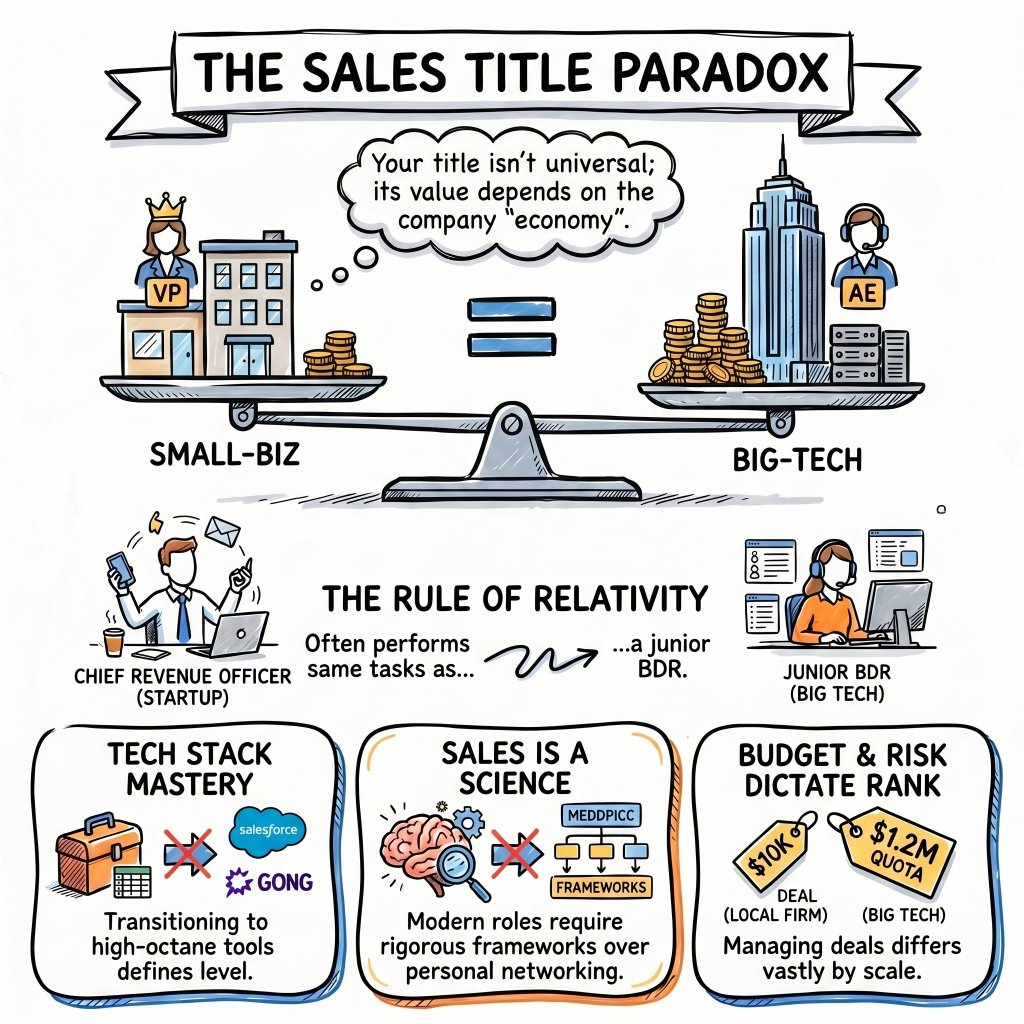
Imagine two people at a networking event. One hands you a card that says "VP of Sales." The other says they're a "BDR." Your instinct might be to assume the VP is the more experienced, higher-level professional.
But what if the VP works at a 10-person local landscaping company, and the BDR works at Google?
That's the Sales Title Paradox — and it's one of the most misunderstood concepts for anyone trying to break into tech sales.
What Is the Sales Title Paradox?
In the world of sales, your title only has meaning in the context of the company you work for. The same title at a small business and at a Fortune 500 tech company can represent completely different levels of skill, responsibility, and complexity.
This isn't about gatekeeping or elitism. It's about understanding the ecosystem you're operating in — so you can accurately position yourself when making a career transition.
The Rule of Relativity: A Real Example
Here's a comparison that might surprise you:
| Industry | Job Title | What They Actually Do | Tech Stack | Deal Size |
|---|---|---|---|---|
| Big Tech (Google, Salesforce, AWS) | BDR | Hyper-specialized prospecting for Fortune 500 accounts | $100k software stack | Enterprise-scale |
| Tech Startup / Scale-up | Account Executive | Data-driven pipeline management using MEDDPICC frameworks | Salesforce, Salesloft, Gong, ZoomInfo | $1.2M individual quota |
| Small Business (Mom & Pop) | CEO / VP of Sales | Generalist — selling, managing the team, and balancing the books | Spreadsheets and cell phones | $10k deal size, $2M firm revenue |
Look at the bottom row. A CEO or VP of Sales at a small local firm is functionally doing the work of a junior BDR at a big tech company — in terms of the sophistication of the tools, processes, and scale involved.
That's not an insult. It's just math.
The 3 Things That Actually Determine Your Level
Forget the title on your business card. In tech sales, your actual level is determined by three things:
1. 🛠️ Tech Stack Mastery
Are you running your outreach on a spreadsheet and your cell phone? Or are you operating a $100,000 software stack that includes tools like Salesforce, Salesloft, Gong, and ZoomInfo?
Learning to operate modern sales technology is one of the clearest signals of where you are in your career journey — and it's one of the first things hiring managers look for.
2. 🔬 Sales Is a Science, Not Just Hustle
In small business sales, relationships and hustle drive results. That's valuable! But in tech sales, you're expected to operate within rigorous, data-driven frameworks like MEDDPICC — a methodology for qualifying whether a deal will actually close.
The shift from "personal network and follow-up" to "pipeline math and structured discovery" is one of the biggest mindset shifts new tech sales professionals need to make.
3. 💰 Budget & Risk Management at Scale
Managing a $10,000 deal at a local firm is not the same as managing a $1.2 million individual quota at a tech startup. The stakes, the stakeholders, and the consequences of missing your number are fundamentally different.
This doesn't mean small business sales experience is worthless — far from it. But it does mean you need to be intentional about how you translate that experience when interviewing for tech sales roles.
Why This Matters for Career Changers
If you're transitioning into tech sales from another industry — retail, hospitality, military, nonprofit, or small business — the Sales Title Paradox is working against you in job applications.
Hiring managers see a title like "Sales Manager" on your resume and mentally place you in the small business column. You need to actively reframe your experience in terms tech sales leaders understand:
- Lead with outcomes: How many calls did you make? What was your conversion rate?
- Show process: Did you follow a repeatable system, or was it ad hoc?
- Demonstrate growth: What did you learn, and how did it make you better?
This is exactly what programs like re:WORK TRAINING are designed to help you do — and why tools like MissionXp exist. The job search itself is a sales process. You need a go-to-market strategy for yourself.
The Takeaway
The Sales Title Paradox is actually good news for anyone breaking into tech sales. It means:
- Your current title doesn't define your ceiling. A CEO at a small firm can absolutely make the jump to a BDR role at a tech company — and quickly advance.
- Skills are transferable, but they need to be translated. You have more relevant experience than you think. You just need to speak the language.
- The gap is learnable. Tech stack, frameworks, and pipeline math can all be learned. The drive and communication skills you already have are the hard part.
So the next time someone makes you feel like your title isn't impressive enough, remember: the game isn't about the title. It's about what you can do — and how quickly you can prove it.
Ready to build your go-to-market strategy for your job search? MissionXp helps you track your pipeline, manage your network, and land your first role in tech sales. Get started for free.