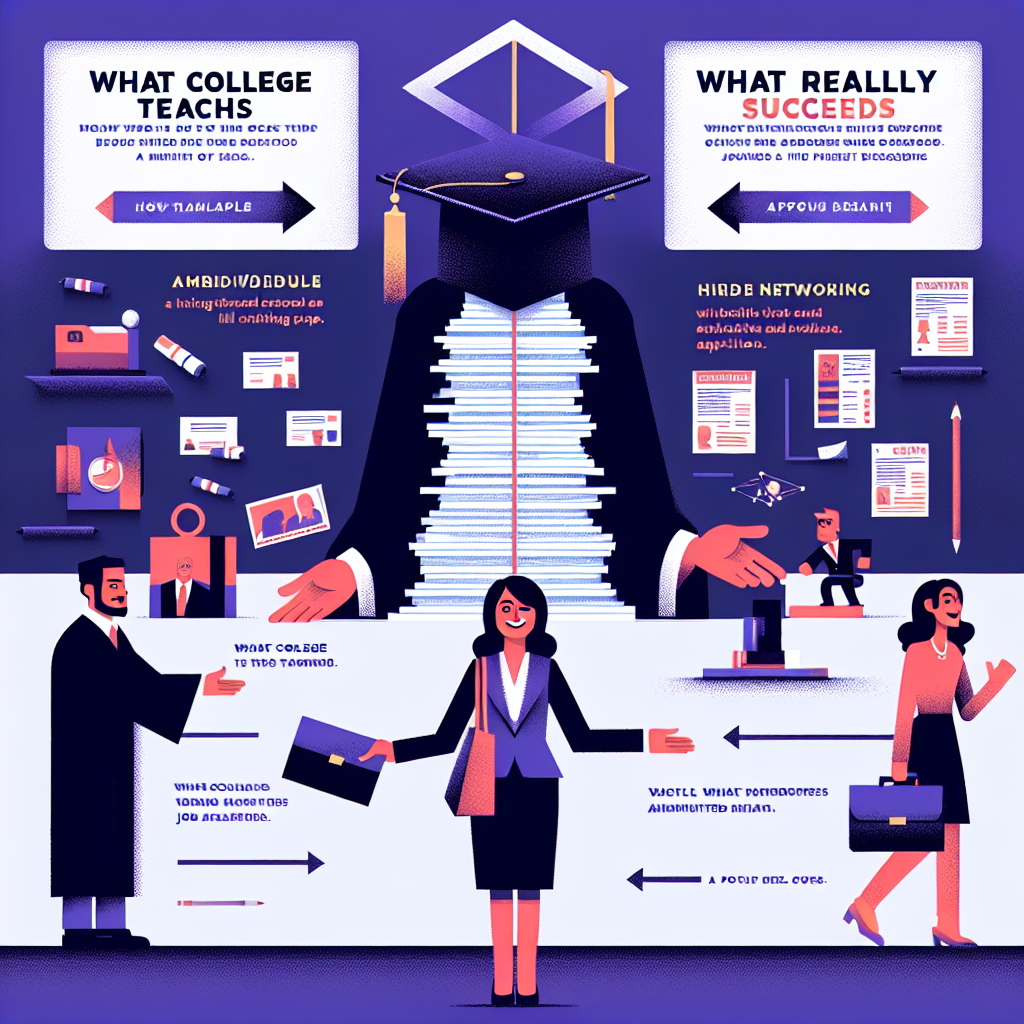
Serious Question: What Job Search Skills Is College Teaching?
You spend four years (and tens of thousands of dollars) learning how to write research papers, solve calculus problems, and memorize historical dates.
Then you graduate. And someone hands you a job board and says, "Good luck."
Here's what nobody told you: the job search is a sales process. And if you don't know how to sell, you're going to struggle — no matter how impressive your GPA is.
The Gap Nobody Talks About
Colleges are excellent at teaching you what to think. They're not so great at teaching you how to get hired.
Here's what most graduates were never taught:
- How to prospect for opportunities before they're posted
- How to position yourself as a solution to a company's problem
- How to build relationships with people you've never met
- How to follow up after interviews without seeming desperate
- How to handle rejection without spiraling
- How to negotiate an offer confidently
Look at that list again. Every single one of those is a sales skill.
Half of Job Seekers Are Playing the Wrong Game
Here's a hard truth:
If half of job seekers took a sales-driven approach to their job search, the job market would look completely different.
I'm not saying the market is easy. It's not. Layoffs are real. Competition is fierce. Economic uncertainty is a factor.
But a lack of strategy makes everything harder.
Most job seekers play the application lottery:
- Find a posting on LinkedIn or Indeed
- Customize the resume (maybe)
- Submit and wait
- Repeat 50 more times
- Wonder why nobody calls back
This is the equivalent of a salesperson cold-emailing 500 strangers with a generic pitch and expecting a 20% close rate.
It doesn't work in sales. It doesn't work in job searching.
What a Sales-Driven Job Search Actually Looks Like
A sales-driven job seeker doesn't start with the job posting. They start with the relationship.
Step 1: Prospect First
Identify the 20-30 companies you'd actually want to work at. Research their teams. Find people on LinkedIn who do what you want to do. Reach out — not to ask for a job, but to learn.
Step 2: Qualify the Opportunity
Not every open role is worth your energy. Does the company culture align with your values? Is the growth trajectory what you need? Is the comp in range? Qualify before you invest.
Step 3: Build Awareness Before You Apply
Do informational interviews. Comment on LinkedIn posts from people at your target companies. Attend industry events. The goal: when your name hits their inbox, it's not cold.
Step 4: Then Apply (The Proposal)
Now your application lands in a warm inbox. Someone on the team already knows your name. Your resume doesn't go in the pile — it goes to the top.
Step 5: Follow Up Like a Pro
Send a thank-you email within 24 hours of every interview. Reference something specific from the conversation. Reiterate your value. This is the follow-up that closes deals.
You Don't Need to Be a Salesperson
You don't need to love cold calling or live for quota. You just need to understand that every human interaction involves some degree of influence.
You're already doing it:
- When you convince your team to try your idea
- When you advocate for yourself in a performance review
- When you walk into an interview and try to get a stranger to believe in you
That's selling. And the students who learn it — regardless of their major — will have an advantage for life.
The Takeaway for Every Graduate (and Job Seeker)
College gave you knowledge. That's valuable.
But strategy is what gets you hired.
Start thinking of your job search as a sales pipeline:
- Build your prospect list (target companies)
- Do your discovery (informational interviews)
- Make your pitch (apply, but warm)
- Close and follow up (negotiate, don't ghost)
The job market isn't waiting for you to figure this out. Start selling yourself — strategically, authentically, and with intent.
Ready to build a smarter job search strategy? Explore our resources and job pipeline tools built specifically for this approach.