This is Part 5 of the "Business of One" series. Catch up on Part 1, Part 2, Part 3, and Part 4 first.
You executed the Same-Day Blitz. You earned the connection. Your name is in their feed.
Now comes the question everyone eventually asks:
How do you actually get inside the company?
When an enterprise is hiring, there are multiple doors you can walk through. 99% of job seekers choose the exact same one — and it is the hardest one to force open. Today, we are going to show you how to find the side door. We call this the Trojan Horse Strategy.
The Two Doors
🚪 Door #1: The Front Door (Traditional Recruitment)
This is the standard application portal. When you walk through this door, you are forced to deal directly with recruiters — the ultimate gatekeepers whose primary job is to filter people out.
The company's defenses are at maximum capacity. Everyone expects you to ask for a job. Their guard is completely up. You are competing against hundreds of identical resumes, and an algorithm is deciding whether you ever get seen.
This is the door 99% of candidates are hammering on. It is exhausting, demoralizing, and statistically stacked against you.
🚪 Door #2: The Side Door (Social Impact)
Almost every major enterprise cares deeply about social impact. They want the brand value and internal morale boost that comes from doing good in the community.
But here is a secret most people do not know: salespeople are historically the last employees to participate in volunteer programs. If an AE has to choose between taking a day off to paint a community center wall or staying at their desk to chase quota — they are chasing quota every time.
What if someone gave them a way to give back by doing exactly what they love — talking about sales?
That is the side door. And it is almost always unlocked.
The Trojan Horse: Bypassing the Gatekeeper
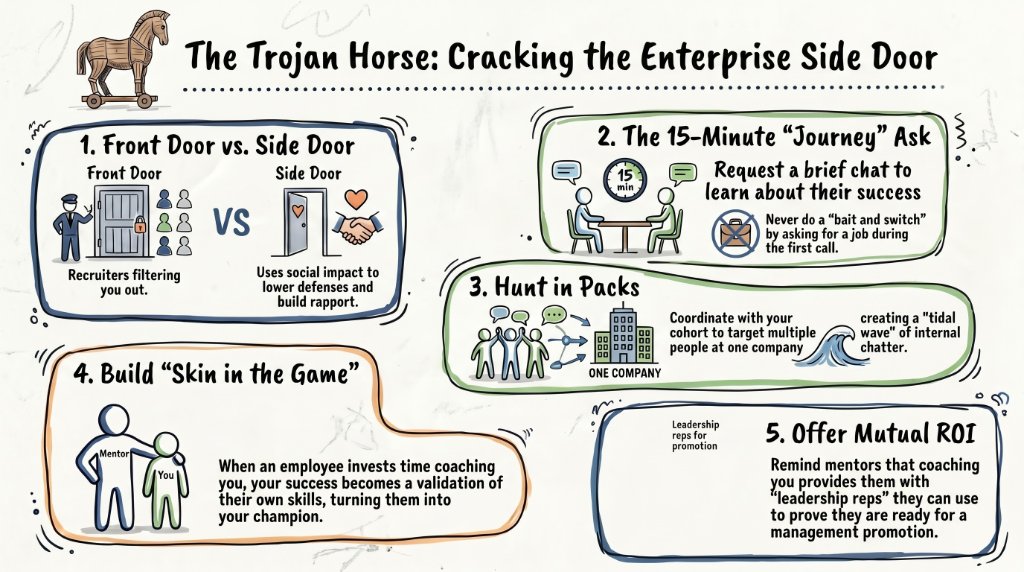
When you take the Trojan Horse approach, you completely bypass the recruiter. You go directly to a salesperson at your target company.
But here is the critical distinction: you do not ask for a job, and you do not ask them to review your cold call script — because reviewing a script feels like work.
The First Ask: You simply ask for 15 minutes of their time to learn about their journey and what made them successful in sales.
That's it. That's the entire ask.
By taking a genuine, personal interest in them under the umbrella of a social impact conversation, you completely lower their defenses. You are an ambitious person seeking to learn from their success. They want to talk to you because people love talking about their own wins — and helping you gives them a meaningful way to give back.
You are now inside the gates.
⚠️ The Critical Rule: Never Do the Bait and Switch
This is the most important rule of the entire strategy, so read it carefully.
If you walk through the Social Impact door, sit down on that 15-minute Zoom call, and immediately hand them a resume or ask for a job referral — you will be met with absolute aggression.
You pretended to care about their journey. But you actually just wanted a favor. You burned the trust before it was ever built, and you will never get it back.
You can never act like you came through the Recruitment door when you walked through the Social Impact door.
You must earn your way to mentorship by proving your coachability and grit over time. Patience here is not weakness — it is strategy.
Why You Hunt in Packs
Here is the secret about corporate philanthropy that most people miss:
Social impact is virtually valueless to an enterprise if it only helps one person.
Companies want to help communities. They want the internal morale boost and the external PR that comes from making a massive, collective difference. One candidate reaching out is a nice gesture. An entire cohort of trained, motivated candidates targeting the same company in the same week?
That is a movement.
In enterprise sales, there are two types of professionals:
- Farmers — They manage existing accounts and wait for inbound leads. (The traditional job seeker waiting for a recruiter to email back.)
- Hunters — They go out, break down doors, and generate their own pipeline.
We train you to be a Hunter. But because the job search is a team game, we train you to hunt in packs.
What Happens When You Coordinate:
Surrounding the Decision Makers: When five different Account Executives at a target company are each contacted by a different re:WORK candidate in the same week, they start talking to each other on the sales floor. You are not just getting one person's attention — you are creating internal buy-in from future co-workers, sales managers, and the VP of Sales.
Activating the Company: When that internal chatter reaches the Social Impact or CSR department, they see a scalable, readymade volunteer program. You give them exactly what they want: community impact at scale.
You do not just crack the side door open for yourself. You blow it off the hinges for your entire team.
The Psychology of the Champion: Skin in the Game
Here is what happens after you successfully execute the Trojan Horse and a salesperson agrees to coach you.
When an Account Executive spends 30 minutes reviewing your cold call delivery and giving you real feedback, a massive psychological shift occurs. They are no longer an objective bystander.
They now have skin in the game.
Human beings value what they invest in. Your success becomes a direct validation of their coaching ability. They want you to get hired because it proves they are a great mentor. You have transformed a stranger into an internal champion who will fight for you behind closed doors — without you ever having to ask.
The Mutual ROI: You Are Helping Them Too
Do not ever feel like you are being a burden when you ask for this mentorship. You are actually handing them a significant career opportunity.
Many top-performing tech salespeople are trying to earn a promotion from Individual Contributor to Sales Manager. Their biggest hurdle? They have no documented proof they can manage or upskill talent.
When you ask them for coaching, you are giving them live leadership "reps." They can take the hours they spent refining your scripts and managing your progress directly to their VP of Sales during their next performance review as proof they are ready for management.
You are not just asking for help. You are helping them earn their next promotion.
That is a deal most people will say yes to.
Every Touchpoint Is a Stealth Working Interview
Finally — and this is essential — you must treat every social impact interaction as a stealth working interview.
While the recruiter at the Front Door is asking you generic behavioral questions like "What is your biggest weakness?", the salesperson at the Side Door is evaluating the only things that actually matter on a sales floor:
- Coachability: When they give you harsh feedback on your script, do you get defensive — or do you immediately apply it?
- Grit: Do you show up prepared, follow up persistently, and actually execute the tasks you discussed?
- Business Acumen: Can you hold a real conversation about pipeline generation and revenue strategy?
Because they are seeing you in a low-pressure, collaborative environment, they get to see exactly who you are. When a hiring manager eventually asks them, "Is this person a good fit?"— they will not say "They have a nice resume."
They will say: "I have been working with them for a month. They are highly coachable, they take feedback instantly, and they know our market. Hire them today."
That is the difference between a resume and a champion. That is what wins offers.
The Data Behind the Strategy
- 🌍 Social impact is enterprise priority: A 2023 CECP report found that 93% of companies offer some form of employee volunteer program — confirming this side door exists at virtually every major enterprise.
- 🤝 Champions close deals: A Gartner study found that B2B buyers who found a salesperson's content helpful were 2.8x more likely to move forward with a purchase. When a salesperson coaches you, they become your internal champion — and they are far more invested in getting you hired.
- 🚀 Mentorship drives mentor success: Research published in the Journal of Vocational Behavior found that employees who act as mentors report higher job satisfaction and career advancement. The person coaching you has just as much to gain as you do.
Your Homework Before Part 6
This week, identify one target company and research who their top-performing salespeople are on LinkedIn. Find someone with a strong content presence — someone who posts about sales, leadership, or their career journey.
Execute the Same-Day Blitz from Part 4. Earn the connection. Then, once you are connected and have made several more deposits, send your 15-minute "journey ask."
Remember the rules:
- Ask about their story. Not yours.
- Do not mention a resume. Do not ask for a referral.
- Show up prepared. Be the person they want to champion.
The side door is always open. Most people just never think to look for it.
Part 5 of the "Business of One" series. In Part 6, we go inside the informational interview itself — the exact questions to ask, how to follow up, and how to turn a 15-minute chat into a standing relationship that gets you hired.