This is Part 6 of the "Business of One" series. Start from the beginning: Part 1 | Part 2 | Part 3 | Part 4 | Part 5
You understand the mindset.
You have built your MVP. You executed the Same-Day Blitz. You know how to find the side door.
Now it is time to actually open your mouth — or in this case, open a message window — and say the right thing.
Because here is the brutal truth about strategy: it is completely useless without execution.
This post is your word-for-word execution playbook. The actual scripts. The exact formulas. The templates you can copy, personalize, and deploy today.
And before we get into a single word of copy, you need to internalize the one rule that governs all of it:
Brevity is revenue. If your message looks like a novel, it will be deleted.
Keep every message punchy, human, and specific. Now let's build your arsenal.
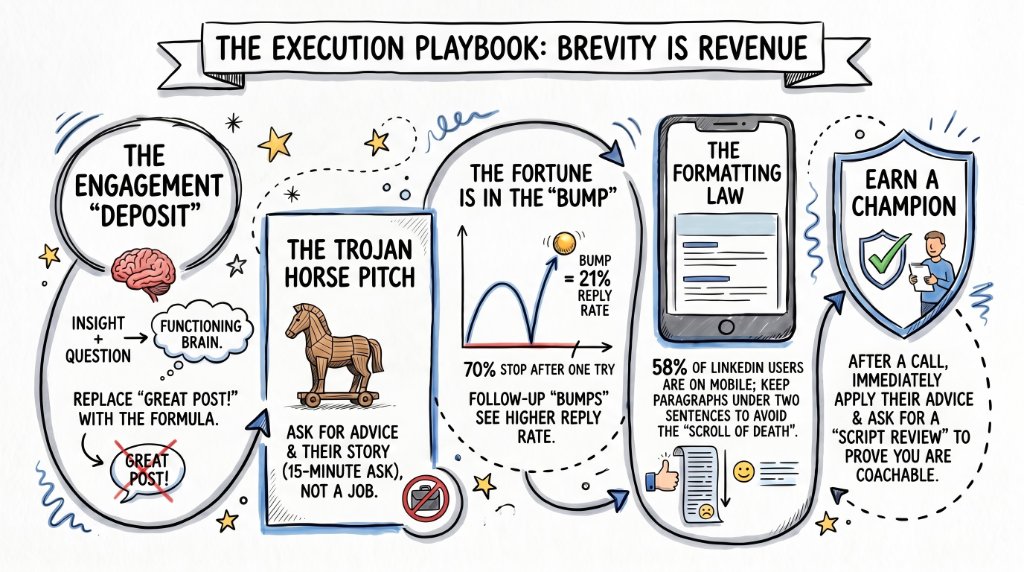
Phase 1: The Engagement Deposit
Before you send a single connection request or pitch, you make deposits. You already know this from Part 4. But how you comment matters enormously.
Do not write "Great post!" or "Thanks for sharing."
That is bot behavior. It signals that you did not read anything. It adds zero value, and it makes you invisible.
Instead, use this formula:
The Formula: Insight + Question
You validate their specific point and invite a reply by asking a smart follow-up question. You are proving you have a functioning brain and actually read their content.
Example 1 (on a project or achievement post):
"Love how you approached the backend on this, [Name]. Did you run into any major bottlenecks when integrating [specific detail from their post]?"
Example 2 (on an industry advice post):
"Spot on. Most people miss that [specific detail] completely changes the pipeline. Have you found this strategy shifts depending on the size of the client?"
You are stroking their ego by validating their point — and you are opening a door they actually want to walk through.
Phase 2: The Connection Note
You have engaged with their content and triggered their notification bell twice. Now you send the connection request.
Remember: your only goal here is the connection. No pitches. No job asks. Not even a hint of one.
The Formula: Context + Validation + Low-Friction Ask
"Hey [Name] – Loved your recent post about [specific detail]. Left a comment, but wanted to connect here as well. Really respect the work you're doing at [Company]. Would love to follow your journey on my feed. Cheers, [Your Name]."
Why this works:
- Context — You explain why you are reaching out (not random)
- Validation — You reference specific work (not generic flattery)
- Low friction — Accepting requires zero effort or commitment on their part
This is not a pitch. This is a handshake. Keep it that way.
Phase 3: The Trojan Horse Pitch (The 15-Minute Ask)
They accepted. You are in their network.
Do not immediately attack them with a pitch.
Let the connection breathe for a day or two. Continue engaging with their content if they post. Then — and only then — initiate the Trojan Horse.
You are coming through the Social Impact door. You are asking for their story, not a job.
The Formula: Context + Research + The "No-Pressure" Ask
"Hey [Name], thanks for connecting.
I'm currently part of an 8-week enterprise sales accelerator at re:WORK TRAINING, focused on social impact and pipeline generation. I'm doing research on elite performers in the space, and your transition from [Past Role] to [Current Role] really stood out.
I know you're busy crushing quota, but would you be open to a 15-minute chat next week? I'd love to hear your story and get your advice on what it takes to win in today's market.
(Promise — no resume drops or job asks. Just looking to learn from the best.)"
Why this works:
- The Context — Establishing your program immediately lowers their defenses. You are not a random stranger; you are part of a social impact initiative.
- The Research — Pointing out their specific career transition proves you did your homework. Generic messages get ignored. Specific ones get responses.
- The Promise — You explicitly call out the Bait and Switch and promise not to do it. This removes every ounce of anxiety they might have about taking the call.
Phase 3.5: The Bump (Handling the Ghost)
In sales, the fortune is in the follow-up.
Most corporate professionals will read your message, mean to reply, get pulled into a meeting, and forget. If you give up after one attempt, you are failing as an SDR.
You need a frictionless "bump" message 3–4 days later that floats your request back to the top of their inbox — without making them feel guilty for not responding.
The Formula: The "No-Guilt" Bump
"Hey [Name] – I know how crazy quarter-end can get, so I don't want to add to the noise.
Just floating this to the top of your inbox in case it got buried. If now is a bad time, no worries at all. Keep crushing it!"
Why this works: It gives them a graceful out. It assumes they are busy — not ignoring you. It requires zero pressure to respond. And according to research by Iko System, 70% of unanswered message chains stop after just one attempt — yet the second message sees a 21% reply rate. Most people quit before the follow-up. Don't be most people.
The Pivot: When They Say "I'm Too Busy"
Sometimes the Trojan Horse lands well — they respect your approach — but they genuinely do not have 15 minutes for a Zoom call.
A novice job seeker says "Okay, thanks anyway" and walks away.
An elite SDR pivots to an asynchronous ask and keeps the relationship alive.
The Formula: The Async Pivot
"Totally understand, [Name]. Time is the most valuable asset right now.
Would you be open to me sending over a 60-second Loom video of me running my cold call script instead? You can tear it apart asynchronously whenever you have 2 minutes to spare.
If not, I completely understand and will keep cheering you on from the feed!"
Why this works: You reduce the ask from a 15-minute scheduled block to a 2-minute asynchronous task. You prove you respect their time. And you demonstrate the exact SDR skill set they are going to want on their sales floor: creative persistence without desperation.
Phase 4: The Post-Call Follow-Up (Earning the Next Step)
You had the 15-minute call. They shared their journey. They have skin in the game.
Now you need to cement them as an ongoing champion — and you do it by proving you are exactly the kind of talent worth championing.
The Formula: Gratitude + Application + The Script Review Ask
"[Name], cannot thank you enough for the time today. Your advice about [specific thing they said] completely shifted my perspective.
I immediately applied that feedback to a cold call script I'm building in my accelerator. If you have 5 minutes this week, would you be open to taking a quick look and tearing it apart for me? I want to make sure I'm executing at an enterprise level.
Thanks again for the coaching."
Why this works: You proved coachability by applying their advice immediately. You are now upgrading them from a one-time conversation into an active, invested mentor — someone who is now personally verifying your Performance Currency.
When a hiring manager eventually asks them about you, they will not describe your resume. They will describe what they watched you do.
The Formatting Law: Mobile-First or Die
Here is a rule that most job seekers never think about:
Over 58% of LinkedIn visits happen on a mobile device (Zippia, 2024). That professional you are messaging is reading it on their phone, between meetings, in an elevator, or during their commute.
If your message looks like a block of text — they will close it before they finish the first sentence.
The Rule: No paragraph longer than two sentences. Use line breaks aggressively. If they have to scroll to read your initial pitch, you have already lost the deal.
Short sentences. White space. One idea per line.
This is not casual writing. This is mobile-first selling.
The Science Behind the Scripts
- 📱 58% of LinkedIn visits are mobile (Zippia, 2024) — formatting is not optional, it is survival.
- ✉️ Successful cold emails average 75–100 words and include specific research about the recipient (Gong.io, 300,000+ email analysis) — validating every element of the Trojan Horse pitch.
- 🔁 70% of message chains stop after one attempt — but the second message sees a 21% reply rate (Iko System) — the bump is not optional. It is where the deal gets done.
Your Homework Before Part 7
Pick one target from your list. This week, run the complete sequence:
- Phase 1 — Leave a real, thoughtful comment using the Insight + Question formula
- Phase 2 — Send the connection note once you've made two deposits
- Phase 3 — Send the Trojan Horse pitch 24–48 hours after they accept
- Phase 3.5 — If no response in 4 days, send the bump
- Phase 4 — After any call, send the follow-up within 24 hours
Track every touchpoint. You are running a sales pipeline, and your career is the deal.
Part 6 of the "Business of One" series. In Part 7, we go inside the informational interview itself — what questions to ask, how to listen like a pro, and how to turn a 15-minute conversation into the most powerful asset in your job search.