This is Part 7 of the "Business of One" series. Catch up: Part 1 | Part 2 | Part 3 | Part 4 | Part 5 | Part 6
You are running the blitz.
You are securing 15-minute Trojan Horse calls. You are earning mentors. You are building real relationships inside target companies.
And if you are doing all of that without logging it into a CRM — you are actively sabotaging your own career.
In enterprise tech sales, there is one universal, unforgiving law:
If it is not in the CRM, it did not happen.
Logging your activity is not administrative busywork. It is the core function of your role as the CEO of your own job search. And here is exactly why it is the most important habit you will build in this entire program.
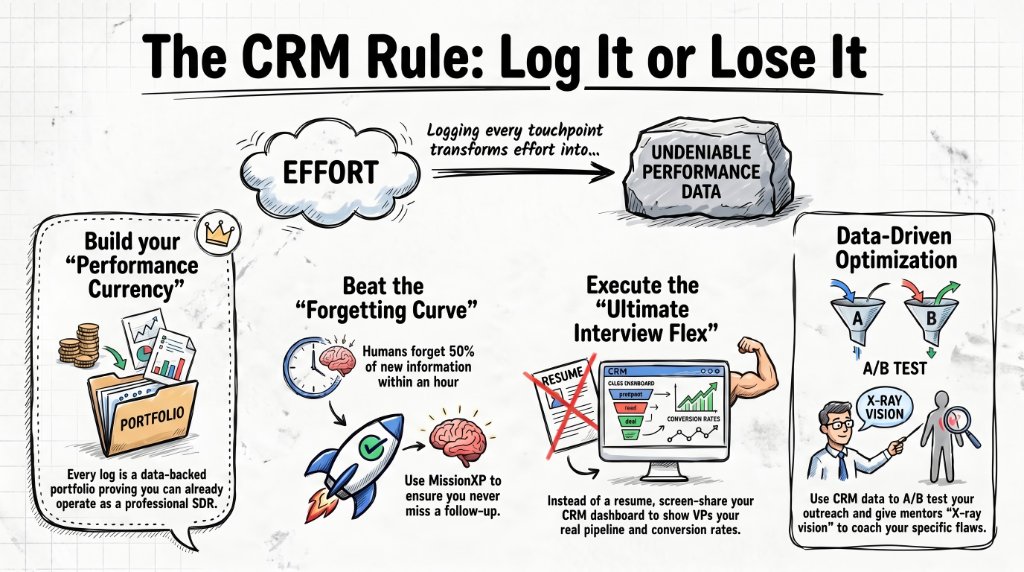
1. You Are Manufacturing "Performance Currency"
We established in Part 1 that the modern hiring system does not care about your resume. It cares about proof.
When you log every single touchpoint — every LinkedIn comment, every connection request sent, every email replied to, every 15-minute Zoom call completed — you are actively generating Performance Currency.
You are building a massive, data-backed portfolio that proves you already know how to operate an enterprise CRM and manage a live pipeline.
You are no longer asking an employer to trust that you can do the job of a Sales Development Representative.
You are generating the hard, undeniable data that proves you are already doing it.
That is a fundamentally different conversation — and a fundamentally different candidate.
2. Pipeline Sanity & Follow-Up Mastery
The fortune is in the follow-up. You already know this.
But as you scale your outreach, you will quickly find yourself juggling 30 to 50 different conversations at various stages of the funnel simultaneously. And your brain will start to fail you.
- Did I send a connection request to Sarah on Tuesday, or was that John?
- Did Mike say to follow up next week or next month?
- Did I already send my script to the AE at Salesforce?
If you try to keep any of this in your head — or worse, on a messy notepad — you will drop the ball. In sales, dropping the ball means losing the deal.
This is not a memory problem. It is a systems problem. And there is a science behind it.
Hermann Ebbinghaus's "Forgetting Curve" shows that humans forget approximately 50% of new information within one hour of learning it. Without a CRM to log details and set reminders across dozens of active conversations, it is scientifically impossible to manage a complex pipeline effectively.
Logging your activity allows you to set automated tasks and reminders so that you execute the perfect follow-up at the exact right moment — proving to every corporate mentor watching that you are a highly organized, reliable professional.
3. Hunting in Packs Requires Radar
You are not doing this alone. You are hunting in packs alongside your cohort. This is Account-Based Selling (ABS) at its core.
But here is what happens when no one logs their activity:
You accidentally pitch the exact same Account Executive that your teammate had a 15-minute call with yesterday. You look uncoordinated. You look unprofessional. And you potentially burn a warm relationship your teammate spent weeks building.
Logging your data ensures the entire pack can see the whole board. It allows your team to strategically surround a target company, divide the contacts, and conquer the account without stepping on each other's toes.
One isolated voice is easy to ignore. A coordinated pack that has already penetrated every layer of a company's sales organization? That is a tidal wave.
4. The Ultimate Interview Flex
This is the endgame. This is why every single log matters.
Eventually, the Trojan Horse will work. Your champions will advocate for you. And you will land an official interview with a VP of Sales or a hiring manager.
Here is what traditional candidates do:
They walk in, hand the VP a piece of paper, and spend 30 minutes trying to convince them they are a hard worker.
Here is what you do:
You pull up your CRM dashboard. You screen-share your pipeline. And you say:
"I don't just want to tell you I can manage a pipeline — I want to show you. Over the last 6 weeks, I've generated 150 target prospects, executed a multi-touch engagement sequence, secured a 15% conversion rate on cold outreach, and booked 12 meetings with enterprise Account Executives. Here is my exact data, and here is how I managed the follow-up."
When you show a VP of Sales real data, pipeline hygiene, and CRM mastery — the interview is over.
You de-risk the hire completely. You bypass the traditional competition entirely. And you close the job offer with proof, not promises.
5. Diagnosing the Funnel — Running Your Own A/B Tests
As the CEO of your career, you cannot make decisions based on feelings. You make decisions based on data.
If you are sending outreach and getting zero responses, you need to know exactly where the breakdown is happening:
- Are your connection requests being ignored — or are people accepting but ignoring the 15-minute ask?
- Is your comment quality attracting profile views but not triggering connections?
- Is your Trojan Horse pitch landing, or is it getting ghosted at the follow-up stage?
Logging your activity surfaces the exact conversion rates at every stage of your funnel. It lets you run A/B tests on your messaging. Send Subject Line A to 10 people and get zero opens. Send Subject Line B to 10 people and get 4. Your CRM tells you to pivot immediately.
You cannot iterate, optimize, or improve what you are not measuring. The data exposes your bottlenecks — and once you see them, you can fix them.
6. Giving Your Mentors X-Ray Vision
When your Trojan Horse mentor asks you, "How is your outreach going?" — how you answer that question will determine the quality of coaching you receive.
Answer A: "It's going okay, I'm trying."
This gives them absolutely nothing to work with. They cannot coach a feeling.
Answer B: "I have a 40% connection acceptance rate, but only a 5% conversion rate on the 15-minute meeting ask."
Now your mentor instantly knows exactly what is wrong. Your profile brand is strong — people are connecting. But your pitch needs work. They can skip the generic advice and go straight to the specific fix.
By logging your data, you give your managers and mentors X-ray vision into your exact performance. The coaching becomes surgical. The improvement becomes exponential.
The Data Behind the Habit
- 📊 Data-driven candidates win: Forrester research found that data-driven organizations are 162% more likely to surpass their goals than peers who operate on intuition. The same principle applies to your job search.
- 💼 CRM mastery signals seniority: A LinkedIn State of Sales Report found that 65% of sales professionals use a CRM, and top performers are significantly more likely to view it as critical to their success. Demonstrating CRM mastery in an interview moves you from "trainee" to "professional" in the VP's eyes.
- 🧠 Your brain will betray you: Ebbinghaus's Forgetting Curve confirms you will forget 50% of new information within an hour. A CRM is not optional — it is the external hard drive your brain cannot be.
Your Homework Before Part 8
Starting today, log everything.
Every comment you leave. Every connection request you send. Every message you write. Every call you take. Every follow-up you owe.
At the end of this week, pull up your data and ask yourself three questions:
- What is my connection acceptance rate?
- What percentage of connections converted to a 15-minute conversation?
- Where in the funnel am I losing the most people?
Your answers will tell you exactly where to focus your energy next week. That is what it means to run a pipeline — not a prayer.
Log it or lose it. There is no third option.
Part 7 of the "Business of One" series. In Part 8, we get into the most underrated move in the entire playbook — how to publicly thank your champions on LinkedIn in a way that turns one relationship into ten, and makes every future hiring manager take notice.