This is Part 8 of the "Business of One" series. Catch up: Part 1 | Part 2 | Part 3 | Part 4 | Part 5 | Part 6 | Part 7
Your pipeline is growing. You are logging your activity. You have scripts that work.
Now we need to talk about something that separates average SDRs from elite ones:
Not everyone on LinkedIn deserves the same play.
If you spend equal time and energy on every single person you find — from interns to CEOs — you will burn out. Your pipeline will collapse. And you will have nothing to show for it.
In enterprise sales, we solve this with an ICP: the Ideal Client Profile.
Your ICP dictates who you target, how much energy you spend on them, and — critically — what specific psychological approach you use to get their attention. Different levels of power require completely different strategies.
Here is how you categorize every target you will ever encounter and map the exact play for each one.
Tier 1: The Whales 🐋
(CEOs, VPs of Sales, Executives)
These individuals have absolute hiring power. One word from them and you are hired. Their time, however, is violently protected.
If you reach out as a single individual asking for 15 minutes of a tech CEO's time, the ROI for them is practically zero. They are not going to do it.
But here is what executives actually love: Thought Leadership and Social Impact. They want to be seen as industry titans who give back. They want their wisdom to reach as many people as possible.
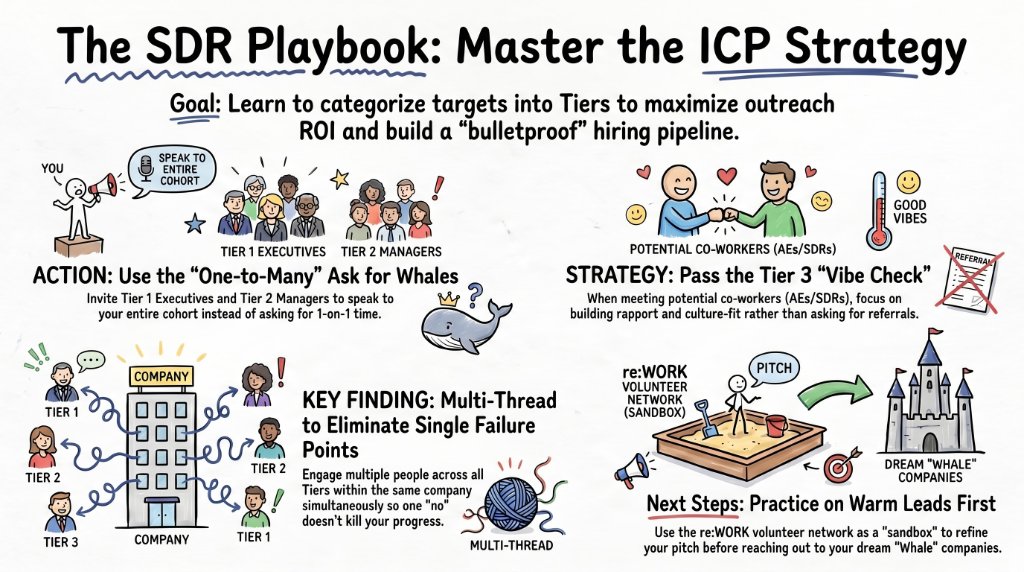
The Play: The "One-to-Many" Ask
Do not ask for a 1-on-1. Leverage your cohort and ask them to speak to a group.
"I am part of a non-profit cohort of 15 SDRs training to break into tech. We would love 20 minutes of your time to tap into your expertise and hear your perspective on the future of sales."
Why this works: It strokes their ego, fulfills their social impact quota, and allows them to impact 15 people in the exact same time it takes to impact one. The ROI for them just went from zero to enormous.
Your job in that room: Stand out. Come prepared with elite, highly researched questions. Lead the conversation without dominating it. Of the 20 people on that Zoom call, be the apex predator they remember.
Tier 2: The Future Boss 👔
(Sales Directors, Frontline Managers)
These are the people who will actually manage you day-to-day. They have direct authority to hire you — and they are drowning in the demands of managing their current team and hitting quota.
The Play: The Group Strategy
Run the exact same "One-to-Many" play. Bring them into a group setting with your cohort. It dramatically lowers the friction of them saying yes, and it gives you a stage to demonstrate your competence in front of peers — which is itself a powerful signal.
Tier 3: The Future Co-Worker 🤝
(Account Executives, SDRs)
These are the people currently doing the job you want. They cannot hire you directly — but they hold two things more valuable than a job posting: the referral and the insider intel.
The psychology here is completely different from Tier 1 and Tier 2.
These people are not evaluating your credentials. They are evaluating one thing:
Are you cool enough to be in the trenches with me?
The Play: The Standard 15-Minute 1-on-1 (The Trojan Horse)
Deploy the full Trojan Horse strategy from Part 5. Your goal is to extract vital intelligence about the company culture, the interview process, and what it actually takes to hit quota in their specific role.
The Golden Rule: Do not ask for a referral.
Your only objective is to build genuine rapport and prove you would be a great teammate. If you are cool enough and competent enough, they will offer the referral themselves.
If they do not offer it? You did not pass the vibe check. That is also valuable information.
Tier 4: The Periphery & Alumni 📬
(HR, Finance, re:WORK Alumni)
These individuals work at your target company but outside the direct sales organization. The value exchange simply is not high enough to justify a 15-minute Zoom call.
The Play: The Async Messenger Interview
Do not ask for a video call. Engage them strictly through LinkedIn Messenger. Ask a few smart, targeted questions via text to build the connection and demonstrate that you value their insight.
A strong Tier 4 connection pays off in ways you cannot predict — navigating internal company politics, pivoting into a different department, or getting a heads-up on a new role before it is posted.
The Golden Rule: Protect Your Dream Pipeline
This is the most important caveat of the entire ICP strategy:
Do not start with your dream company or your Tier 1 Whales.
You are learning. You are going to stumble over your words. Your messaging will be clunky. Your discovery questions will need refinement. You will make mistakes.
Why would you make those mistakes on the CEO of the one company you desperately want to work for?
Start with warm leads. Use your program's volunteer network as your sandbox. Practice your pitch, refine your 15-minute calls, and master the psychology of the ICP in a low-stakes environment.
You only pivot to your cold, high-value dream targets once your skills are sharp and your execution is flawless. Protect your shot.
Advanced Tactics: How Elite SDRs Work a Full Account
1. Multi-Threading: Eliminate Single Points of Failure
In enterprise sales, if you only talk to one person at a target company and that person ghosts you, leaves the company, or says no — your deal is dead. You have a "single point of failure."
Elite SDRs solve this by Multi-Threading: actively engaging multiple ICP tiers within the same company at the same time.
- Engaging the SDR (Tier 3) on LinkedIn to learn about the day-to-day culture
- Coordinating with your pack to get the VP of Sales (Tier 1) on a group call
- Casually messaging an HR rep (Tier 4) to understand current hiring timelines
When you multi-thread, one "no" does not kill your deal. You are already talking to four other people inside the same building.
Gartner research confirms that the typical B2B buying group for a complex solution involves 6 to 10 decision-makers. A candidate who only speaks to one person is missing the rest of the hiring committee.
2. Top-Down Leverage: Using the Whale to Catch the Fish
Once you successfully execute a group call with a Tier 1 or Tier 2 Whale, you have acquired a massive piece of leverage: their name.
When you reach out to a busy AE who might otherwise ignore you, send this instead:
"Hey [Name], my re:WORK cohort just had an incredible group session with your VP of Sales, [VP's Name]. Their vision for [specific initiative] was brilliant. I'd love to get 10 minutes to hear how that vision actually translates to your day-to-day on the sales floor."
You instantly bypass the stranger zone. You have name-dropped their boss and proven you already have access to their leadership. The AE will take that call every single time.
3. Persona-Based Messaging: Match Your Curiosity to Their Altitude
Your strategy changes per tier — and so should your messaging hook. Each tier has completely different pain points and priorities:
| Tier | They Care About |
|---|---|
| Tier 1 (Whales) | Macro-trends, revenue scale, company brand, legacy |
| Tier 2 (Bosses) | Hitting team quota, reducing ramp time, coachability |
| Tier 3 (Co-Workers) | Daily grind, commission structures, tech stack, surviving the quarter |
If you ask a CEO "What is your favorite cold calling tool?" — you have proven you do not understand their altitude. A CEO thinks in Go-To-Market strategy, not tools.
Ask the CEO: "How is AI changing your GTM strategy heading into 2025?"
Match your curiosity to their level of responsibility. That is what makes you sound like a peer instead of a job seeker.
The Data Behind the Strategy
- 🎯 Account-Based Selling delivers: A 2023 Terminus report found that 87% of marketers say ABM delivers higher ROI than other outreach strategies — confirming that targeted, tiered account focus beats spray-and-pray every time.
- 🔗 Multi-threading is non-negotiable: Gartner research shows the average B2B hiring decision involves 6–10 stakeholders. One relationship is never enough.
Your Homework Before Part 9
Pick one target company and map it across all four tiers right now:
- Tier 1 — Find the VP of Sales or a C-suite executive. Note their content and thought leadership.
- Tier 2 — Find a Sales Director or Frontline Manager. Check if they post about managing their team.
- Tier 3 — Find 2–3 Account Executives or SDRs currently in the role you want.
- Tier 4 — Find an HR business partner or a program alumni at that company.
Log every contact into your CRM. Build the map. Then deploy the right play for each tier.
This is not networking. This is Account-Based Selling — and you are the product.
Part 8 of the "Business of One" series. In Part 9, we cover the most underrated move in the entire playbook — the LinkedIn Thank-You Post that turns one champion relationship into a network of ten and signals to every hiring manager watching that you are exactly the kind of talent worth investing in.