This is Part 9 of the "Business of One" series. Catch up: Part 1 | Part 2 | Part 3 | Part 4 | Part 5 | Part 6 | Part 7 | Part 8
The Trojan Horse worked. The 15-minute call is on the calendar.
Now most job seekers do the same thing: they show up, ask a few generic questions, smile a lot, and hope the person on the other end likes them enough to put in a good word.
That is a guaranteed way to be forgotten.
As an SDR, you treat the informational interview as a Reconnaissance Mission.
You are conducting elite-level Discovery. Your goal is to extract highly specific intelligence that you will weaponize when you step into the formal job interview. You are not there to charm anyone. You are there to gather data, build rapport, and leave a mark so sharp they remember you weeks later.
Here is exactly how you dominate every informational interview from opening question to closing move.
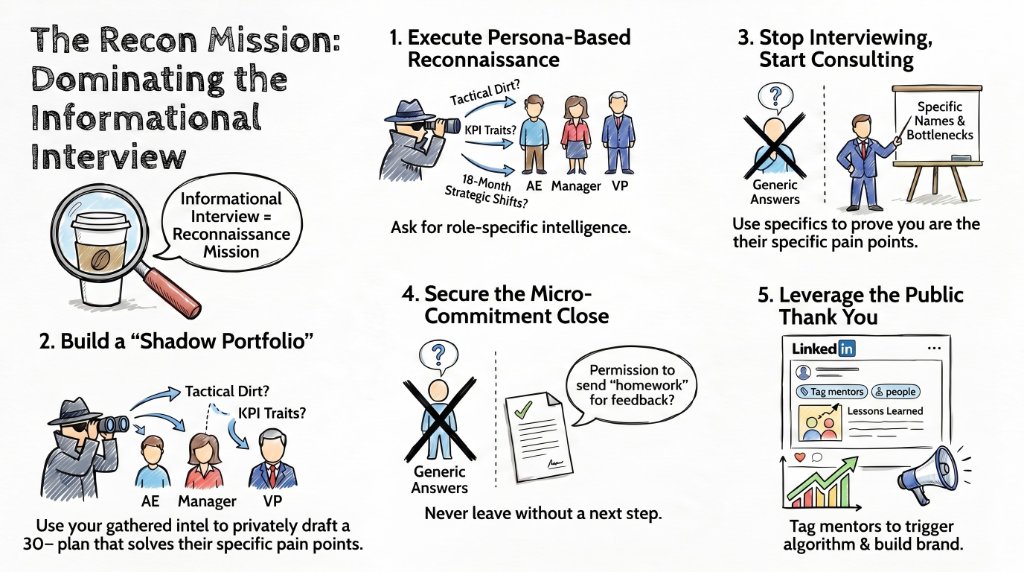
Step 1: Persona-Based Reconnaissance
You cannot ask the same questions to a CEO that you ask an SDR. Each tier has a completely different relationship to their company's pain, and you need to extract the intelligence that is relevant to their altitude.
🎯 Targeting Tier 3: The Future Co-Worker (AEs / SDRs)
Your goal: Uncover the unvarnished reality of the day-to-day grind. You want the tactical dirt that never appears on the company's "Culture" page.
The intel to extract: Tech stack reality, quota attainment truth, and the ground-level objections their prospects are throwing at them right now.
High-value questions to ask:
"Every company has a shiny culture page on their website — what is the actual reality of the sales floor here?"
"What is the number one objection your prospects are hitting you with this quarter, and how is the team navigating it?"
"If I were to start as an SDR here tomorrow, what is the one piece of the tech stack I need to master on day one to not fall behind?"
🎯 Targeting Tier 2: The Future Boss (Sales Managers / Directors)
Your goal: Understand their management style and what separates their top earners from the people who get fired.
The intel to extract: KPI metrics, onboarding expectations, and the anatomy of a top performer on their specific team.
High-value questions to ask:
"When you look at the top 10% of your reps, what is the one behavioral trait they all share that the middle-of-the-pack reps lack?"
"What is the biggest bottleneck in your team's pipeline right now — is it top-of-funnel generation or closing the deal?"
"How do you measure success for a new hire in their first 30 days? What proves to you that you made the right call?"
🎯 Targeting Tier 1: The Whales (VPs of Sales / C-Suite)
Your goal: Understand the macro-vision and the existential threats to the business.
The intel to extract: 12-to-18-month strategic goals, market positioning, and Go-To-Market direction.
High-value questions to ask:
"Looking at the next 18 months, what is the biggest strategic shift your Go-To-Market team has to make to stay ahead of the competition?"
"How is AI currently forcing your organization to adapt its sales process?"
Step 2: Build the Shadow Portfolio
Once you complete your informational interviews, you possess something that no candidate applying through the front door has: Insider Intelligence.
You know what the company is struggling with. You know the objections their reps are facing. You know what the managers are desperately looking for.
Now you take that intel and build a Shadow Portfolio.
This means you privately draft a 30-60-90 day plan — or write a new cold call script — designed specifically to solve the exact problems you just uncovered. You do not share it yet. You build it, sharpen it, and hold it until the formal interview.
A survey of hiring managers by The Muse found that presenting a 30-60-90 day plan significantly impresses interviewers because it demonstrates foresight, proactivity, and a commitment to hitting the ground running. The Shadow Portfolio is your secret weapon for delivering exactly that.
Step 3: Weaponize Your Intel in the Formal Interview
Your networking pays off. You land the official interview with the Hiring Manager.
A traditional candidate walks in and says: "I'm a fast learner and a hard worker."
You walk in and drop a tactical nuke of preparation.
When the Hiring Manager asks "Why do you want to work here?" — most candidates give a rehearsed non-answer about company culture. You deliver this:
"I want to work here because I know exactly what I'm walking into. Over the last three weeks, I've had informational interviews with your AE John and your SDR Manager Sarah. John told me the biggest objection on the floor right now is budget pushback due to Q3 constraints. Sarah mentioned your biggest pipeline bottleneck is top-of-funnel generation in the mid-market sector.
I want to work here because I've already built a prospecting sequence specifically designed to bypass that budget objection and attack the mid-market. I'm not here to figure the job out. I'm here to execute the solution."
When you answer like that, you are no longer interviewing.
You are consulting.
You have proven you have the hustle to build an internal network, the business acumen to ask the right questions, and the capability to solve their immediate pain points before you have even been hired. The formal interview becomes a formality.
Step 4: The Micro-Commitment Close
In enterprise sales, you never leave a meeting without securing a Next Step.
Most job seekers end the informational call with "Thanks so much for your time, bye!" That is a dead end. The relationship dies the moment the Zoom window closes.
Instead, in the final 60 seconds of every call, you secure a Micro-Commitment: explicit permission to follow up, which keeps the door permanently propped open.
The Script:
"[Name], I know we're at time. Your insight on [specific bottleneck they mentioned] was exactly what I needed. I'm actually going to build a new outreach sequence to tackle that exact problem. Would you be opposed to me sending it over next week so you can see what I built with your advice?"
You are not asking for a job. You are asking for permission to show them your homework.
You just guaranteed your next interaction with them. And the interaction after that is where the referral lives.
Step 5: Passing the Impromptu Test
When you ask high-level, tactical questions to elite salespeople, something interesting happens. They realize you are operating at a higher level than a standard job seeker — and they want to test your reflexes.
Be prepared for them to flip the script mid-call:
"You know what? Pitch me right now. Let's hear your cold call opener."
The Rule: Never apologize. Never freeze.
Do not say "Oh, I'm not really prepared for that." An SDR gets hit with unexpected objections all day long. This moment is the stealth working interview.
- Take a breath
- Deliver your pitch with confidence
- Immediately ask for critical feedback: "Tear that apart. What was the weakest part of my tone?"
They do not expect your pitch to be perfect. They are testing your courage and coachability under pressure. Lean into the test eagerly. Ask for the critique. That is exactly how you earn their ultimate respect.
Step 6: The Give-Get Dynamic
It feels unnatural to think you can provide value to a VP of Sales when you are just starting out. But you absolutely can.
As someone executing this playbook, you are actively talking to dozens of AEs and SDRs across multiple companies. You have a real-time pulse on the wider market that a VP — who is locked inside their own company's bubble — may not have.
You can use this to create a Give-Get dynamic: you give them a piece of market intel, and you get their respect in return.
The Script:
"I've been speaking with SDRs at three other SaaS companies in your sector this week, and almost all of them mentioned that cold email open rates have dropped by 20% this quarter, forcing them back to the phones. Are you seeing that same trend here, or has your team found a workaround?"
By sharing aggregated market intel, you elevate yourself from "student" to peer. You prove you are a true Hunter who understands the broader landscape of their industry — not just someone looking for a handout.
Step 7: The Public Thank You
Once your informational interviews are done, you owe them a thank you. But limiting that gratitude to a private DM is a massive missed opportunity.
You must leverage the Law of Reciprocity publicly.
This strategy also solves one of the biggest content problems job seekers face: How do I create relevant LinkedIn content when I don't have industry experience yet?
The Execution: The "Rule of Three" Post
At the end of the week, group three of your informational interview conversations together into a single LinkedIn post:
- The Format: Write a post summarizing the top three tactical lessons you learned that week about the realities of enterprise sales.
- The Tag: Explicitly tag all three professionals, thanking them for their time, mentorship, and transparency.
Why this is a strategic masterclass:
-
🔔 The Dopamine Hit — When you publicly highlight how brilliant their advice was, you trigger the notification bell psychology from Part 4. People love being recognized as industry experts. They will engage with that post every time.
-
🌐 Network Cross-Pollination — When those three professionals like or comment on your post, the LinkedIn algorithm broadcasts your face, your MVP, and your work ethic directly to their entire networks. You just got three elite professionals to co-sign your hustle in front of their peers, their managers, and the VPs who might be looking to hire.
-
✍️ Effortless Brand Building — You never have to stare at a blank screen wondering what to post. By documenting your reconnaissance missions, you automatically generate high-value, industry-relevant content that proves you are actively doing the work.
The Data Behind the Tactics
- 🔍 Discovery is the #1 differentiator: A RAIN Group study found the single biggest factor separating top-performing salespeople from the rest is their ability to uncover insights during discovery. The informational interview is your discovery call.
- 🧠 Business acumen closes deals: Korn Ferry research identifies "Business Acumen" as one of the most critical and sought-after competencies for sales professionals. Persona-based questions are a live demonstration of this skill.
- 📋 30-60-90 plans win rooms: Hiring managers surveyed by The Muse confirmed that candidates who present a 30-60-90 day plan significantly stand out — because it shows they are already thinking like an employee, not a candidate.
Your Homework Before Part 10
After your next informational interview, do three things:
- Log the intel in your CRM immediately — every pain point, bottleneck, and insight they shared.
- Build one Shadow Portfolio asset — a 30-day plan or a cold call script that directly solves a problem they mentioned.
- Write the Rule of Three post — tag your mentors, share what you learned, and watch the algorithm do the work for you.
The informational interview is not a coffee chat. It is the single most powerful competitive weapon in your entire job search.
Use it like one.
Part 9 of the "Business of One" series. In Part 10, we cover the final chapter — how to close the offer, negotiate like a professional, and set yourself up for the promotion before you even start the job.