This is Part 11 of the "Business of One" series. Catch up: Part 1 | Part 2 | Part 3 | Part 4 | Part 5 | Part 6 | Part 7 | Part 8 | Part 9 | Part 10
You understand the mindset. You have the strategy. You know the equation.
Now we strip away the theory and look at the raw data.
A real candidate — executing this exact playbook — produced a live MissionXp dashboard that tells the full story. They did not rely on luck. They did not rely on hope. They relied on pipeline math.
Within 60 days, this level of execution yielded a massive outcome: multiple job offers.
If you want the 60-day results, you have to execute the 60-day math.
The Anatomy of a Winning Dashboard
When a VP of Sales looks at this dashboard, they do not see a job seeker.
They see a fully ramped Business Development Representative.
Here is exactly how the metrics break down — and why each one matters.
📊 1. Touches Made: 1,000+ — The Cadence
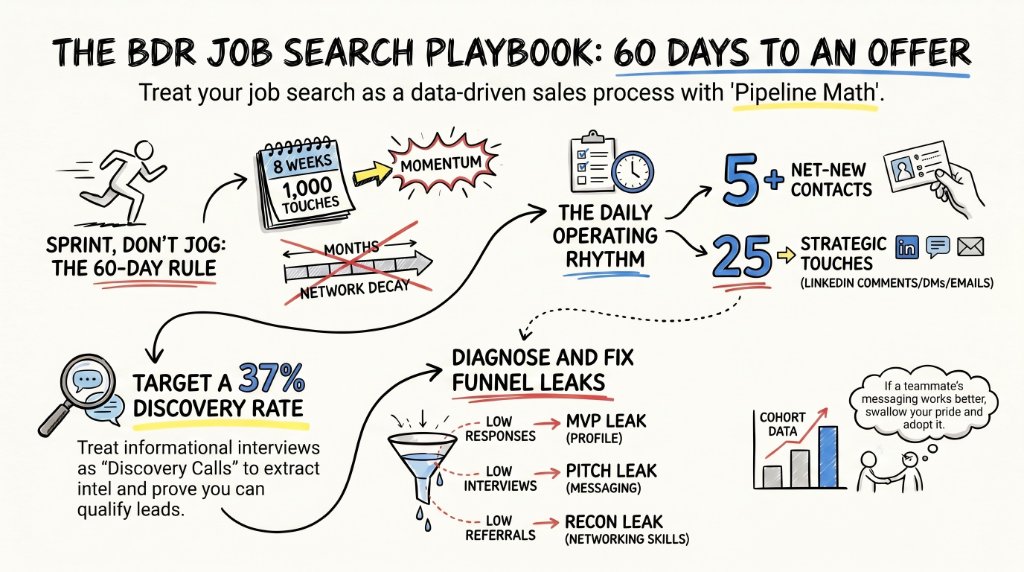
A "touch" is any activity: a LinkedIn comment, a direct message, an email, a follow-up bump. 1,000+ touches in 60 days is the reality of enterprise sales. It proves relentless consistency — and consistent follow-up is the single most important BDR skill.
This number alone signals to every hiring manager: this person already knows how to work a sales floor.
👥 2. Contacts Added: 212 — The Pipeline Size
You cannot multi-thread accounts or execute the Trojan Horse strategy if your network is empty. Adding 212 targeted ICP contacts over 60 days means actively hunting, filtering, and prioritizing prospects every single day — not in bursts, not on weekends.
🎯 3. Discovery Rate: 37.7% — The Informational Interviews
This candidate converted over a third of their connected prospects into informational interviews.
In the enterprise world, an informational interview is a Discovery Call. The questions you ask your prospects map 1:1 to what BDRs do daily to qualify leads. A 37.7% discovery rate does not just prove networking skill — it proves you can qualify a pipeline.
🏆 4. Champion Rate: 10.4% — The Internal Advocates
Out of 212 cold prospects, this candidate generated 22 internal champions.
Champions = Customer Success. Every champion you earn is proof you can build genuine relationships and consensus from a completely cold start. These 22 people are the Social Capital that drove the final job offers. They walked the candidate's name to hiring managers before a single formal application was submitted.
📈 5. Pipeline = Revenue Pipeline
Hiring managers love candidates who manage their job search like a sales process. This dashboard proves the candidate knows how to track stage advances, manage a funnel, and close a deal.
That is not a soft skill. That is the job.
Your Daily Operating Rhythm: The Non-Negotiable KPIs
To achieve these results over an 8-week (40 working day) sprint, you must treat your day like a shift on the sales floor. You cannot cram this into the weekend.
Here are the numbers you must hit every single day:
⚡ Daily Execution
| KPI | Target | What It Does |
|---|---|---|
| Net-New Contacts Added | 5 per day | Fills the top of your funnel with targeted ICPs |
| Strategic Touches | 25 per day | Blitz comments, Trojan Horse DMs, no-guilt bumps |
| Unlogged Activities | Zero | If it isn't in MissionXp, it didn't happen |
Zero Unlogged Activities is not optional. If you do the work but don't log the touch, you are destroying your own Performance Currency. The data is the proof.
📅 Weekly Execution
- 2–3 Informational Interviews (Discovery Calls): Run your reconnaissance missions on Zoom every week. No intel extraction = no Shadow Portfolio = no edge in the formal interview.
- 1 "Rule of Three" LinkedIn Post: Synthesize your week's intel, tag three mentors publicly, and generate inbound visibility from the algorithm.
When you hit these KPIs daily, 1,000 touches and 200+ contacts become a mathematical certainty. You remove the emotion of rejection, let the pipeline mature, and force the market to hand you an offer.
Diagnosing the Funnel: Reading the Data Like a VP
A dashboard is only valuable if you know how to read it.
If you are not getting job offers, your dashboard will tell you exactly why. As the CEO of your Business of One, you must learn to find the leaks.
There are exactly three places where pipelines break:
🔴 Leak #1: The MVP Leak
Symptom: High Touches + Low Contacts (connections not accepting)
If you are sending 100 connection requests but only 5 people accept, your Trojan Horse pitch is not the problem. Your LinkedIn profile is weak — or your initial connection message sounds like a bot.
Fix: Revisit Part 3. Rebuild your MVP landing page. Audit your connection note.
🔴 Leak #2: The Pitch Leak
Symptom: High Contacts + Low Discovery (calls not booking)
If people are accepting your connection requests but nobody is agreeing to a 15-minute call, your Trojan Horse strategy is failing. Your message is either too long, too pushy, or clearly a Bait and Switch.
Fix: Revisit Part 5. Cut your message by 40%. Remove all job-seeking language.
🔴 Leak #3: The Recon Leak
Symptom: High Discovery + Low Champions (calls not converting to advocates)
If you are getting the 15-minute calls but earning zero champions or referrals, your networking skills are the problem. You are either asking generic questions, talking too much, or failing the vibe check with Tier 3 co-workers.
Fix: Revisit Part 9. Deploy persona-based reconnaissance. Stop talking. Start extracting.
The Law of Momentum: Compression vs. Dilution
Here is the most important principle in this entire series:
Making 1,000 touches over 60 days will get you a job.
Making 1,000 touches over 6 months will get you nothing.
In pipeline generation, momentum is everything. If you stretch your activity out over half a year, your network decays. The AE you spoke to in January has completely forgotten who you are by June.
When you compress your activity into a ruthless 60-day sprint, you create a tidal wave of internal chatter, follow-ups, and market presence that hiring managers cannot ignore.
You must sprint. You cannot jog.
This is why the playbook is built around an 8-week window — not a 6-month "I'll apply when I feel ready" approach. Momentum is either building or decaying. There is no neutral.
Benchmarking Against the Pack
re:WORK candidates hunt in packs — and their dashboards are not isolated.
If your Discovery Rate is stuck at 15% but your teammate is sitting at 45%, you do not complain that the market is bad. You look at the data, swallow your pride, and ask your teammate exactly what subject line they are using.
The dashboard allows the pack to share winning plays. When one person cracks the code on a specific target company, the entire cohort adopts that messaging and scales the success.
Data-driven peer learning platforms like Gong.io and Chorus.ai are built on this exact principle — identifying the talk tracks of top performers and spreading them across the team. The same logic applies to your job search cohort.
Data eliminates guesswork. Data elevates the entire team.
The Math That Creates the Offer
Let's run the full 60-day calculation:
- 40 working days × 5 new contacts/day = 200 contacts
- 200 contacts × 37% discovery rate = ~74 informational interviews
- 74 interviews × 10% champion rate = ~7 internal advocates
- 7 advocates across multiple companies = multiple simultaneous referrals
- Multiple referrals = competing offers = negotiating leverage
This is not motivation. This is not a pep talk.
This is arithmetic.
Your Action Items Before Part 12
- Audit your current KPIs. Open your MissionXp dashboard right now. Are you hitting 5 contacts and 25 touches per day? If not, which day this week did you fall short?
- Diagnose your leak. Look at your funnel conversion rates. Is your bottleneck at connections, calls, or champions? Identify it, name it, and fix it with the corresponding strategy from earlier in this series.
- Commit to the 60-day sprint window. Set a start date. Set an end date. Tell someone about it. Sprint.
The candidate in this dashboard is not special. They are not exceptionally talented or uniquely connected.
They just did the math — every single day.
Part 11 of the "Business of One" series. In Part 12, we cover the final chapter: how to handle the offer, negotiate compensation without burning the relationship, and engineer your 30-day onboarding to guarantee you are the best hire your new manager has ever made.